

Despite significant advancements in biometrics and passkey deployments, standard alphanumeric string passwords remain the foundational entry point for consumer and enterprise authorization. However, the human brain is mathematically unequipped to generate or memorize true cryptographic randomness. Under friction, users consistently fallback on predictable cognitive frameworks.
Cybercriminals do not guess passwords manually. They deploy automated cracking tools, cloud-based GPU rigs, and highly optimized script frameworks designed to parse millions of predictable human habits instantly. This guide breaks down the core structural flaws of human-designed passwords from a cryptographic perspective and shows how to neutralize those specific attack paths.
The Top Architectural Vulnerabilities in Modern Password Selection
1. Low Algorithmic Entropy and Dictionary Vulnerabilities
Relying on legacy strings like 123456, qwerty, or variations containing your name, company name, or birth year introduces a massive structural flaw. These strings possess extremely low entropy—the mathematical calculation of a value’s unpredictability. Automated offline cracking frameworks like Hashcat utilize pre-built wordlists containing millions of these known strings. When testing a database hash, these dictionary files are executed first, breaking low-entropy secrets in milliseconds.
2. Cross-Platform String Reuse (Credential Stuffing Vector)
Utilizing a single baseline password across multiple separate web applications is the most destructive credential mistake a user can make. When a low-security merchant site or forum suffers a database breach, attackers parse the exposed credentials and feed the extracted username-password combinations into automated testing suites. These frameworks execute Credential Stuffing attacks across high-value services like banking infrastructure, primary email databases, and cloud service endpoints. If the string is identical, the high-security system falls instantly due to an upstream failure.
3. Predictable Structural Leaps (Sequential Increments)
When users are forced to change a password, they rarely alter the baseline architecture of the string. Instead, they shift Spring2025! to Summer2025! or alter a trailing number sequentially. Modern password cracking engines use sophisticated custom rulesets that explicitly test for these predictable increments. If an attacker has access to an outdated plaintext password from an old breach, their brute-force scripts will automatically prioritize these standard variations.
4. Cleartext Storage Mechanisms
Documenting your credentials in unencrypted physical text files, notes apps, or spreadsheet documents leaves your data highly exposed. If an endpoint is infected with an info-stealer Trojan or exposed to local physical unauthorized access, cleartext documents are instantly collected and exfiltrated within seconds.
5. Relying on Unprotected Web Browser Autofill Engines
While web browsers offer native password saving, storing your primary passwords inside a standard browser profile without a mandatory master password validation can be a massive risk. Many forms of desktop malware are engineered to extract the local SQLite databases where browsers store saved credentials, decrypting them effortlessly if the browser profile lacks an independent master encryption boundary.
The Mathematical Path to Strong Identity Protection
To eliminate human behavior vulnerabilities entirely, transition your credential architecture to adhere to modern cryptographic standards:
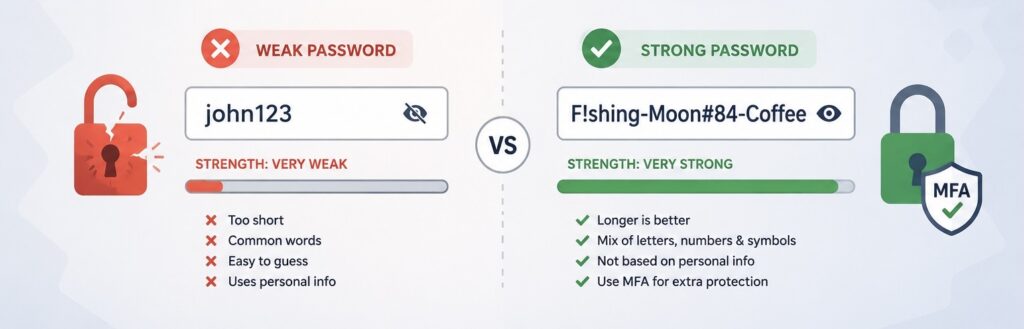
Prioritize Character Length Over Artifical Complexity: Brute-force calculation complexity scales exponentially with string length, not characters. A short password with random symbols like p@$$w0rd! can be cracked in minutes by multi-GPU arrays. However, a long passphrase built from 4-5 completely random words (e.g., CorrectHorseBatteryRiverCloud) creates an incredibly deep cryptographic search space that would require decades of computational runtime to crack, while remaining much easier for a human to remember.
Deploy an Independent Zero-Knowledge Password Manager: Utilize a dedicated credential platform (such as Bitwarden, 1Password, or KeepassXC) built on a zero-knowledge architecture. These tools encrypt your vault data locally using AES-256 before syncing anything to the cloud. The service provider never handles your master plaintext password or encryption keys, meaning your data remains protected even if the vendor’s data servers are fully compromised.
Isolate MFA Delivery Channels: Standard passwords should never act as a single line of defense. Force Multi-Factor Authentication (MFA) across every asset, using dedicated software authenticator tokens (TOTP via Google Authenticator or Aegis) or FIDO2 hardware tokens instead of SMS protocols, which are highly vulnerable to network-level intercept attacks.
Frequently Asked Questions
Why is substituting letters with characters like “@” for “a” or “3” for “e” ineffective?
Because these substitutions follow predictable l33tspeak logic. Modern brute-force engines include specialized rulesets that automatically check these precise character swap variations during the cracking process, giving them zero extra mathematical strength against automated tools.
Is storing physical credentials written down in a secure ledger safe?
Yes. From a pure cyber threat-modeling standpoint, a locked physical notebook is completely insulated from remote global network attacks. If the notebook remains physically secure inside your home, it provides far better security than reusing the same password across multiple online accounts or saving them in a plain text file on your desktop.
Conclusion
Effective authentication security requires eliminating human patterns. By recognizing that attackers leverage rapid computational rule-checking to crack human habits, you can shift your strategy toward high-entropy passphrases, zero-knowledge storage engines, and strict multi-factor isolation boundaries to keep your digital infrastructure safe.

Martins Osad is a technical writer and systems administrator specializing in network architecture and endpoint security operations. With over ten years of experience managing infrastructure deployment and configuring firewalls. All technical guides on Cybersafeguide are personally tested and verified in sandboxed environments.