

For decades, modifying corporate and personal credentials on a strict periodic cycle was considered a foundational commandment of basic cybersecurity hygiene. Organizations across the globe routinely enforced mandatory password resets every 30, 60, or 90 days, operating under the assumption that frequent rotations would compress the window of opportunity for an attacker utilizing a compromised key.
Today, that traditional paradigm has completely shifted. Leading cybersecurity bodies—most notably the National Institute of Standards and Technology (NIST) via its updated SP 800-63B guidelines—now officially advise against forced, calendar-based password rotations. Security researchers have demonstrated that forcing users to change secrets too frequently actively degrades defensive architecture. This technical breakdown explores why legacy rotation policies backfire, defines the specific parameters that demand an immediate password reset, and outlines modern identity hardening strategies.
The Flawed Logic of Calendar-Based Rotations
The original thesis behind frequent password changes made intuitive sense in an era before advanced algorithmic cracking rigs: if a threat actor intercepted a plaintext password, a scheduled reset would eventually invalidate their backdoor access.
However, human behavioral patterns under friction-heavy constraints quickly undermined this protection. When human operators are forced to invent complex new strings four to twelve times a year, they predictably reject true randomness and take cognitive shortcuts to ease memory burdens. This introduces predictable vulnerabilities that automated attack frameworks can easily bypass.
Why Mandatory Resets Compromise Security
Instead of generating highly random, high-entropy passwords, forced rotation environments encourage users to employ predictable permutations, such as:
- Sequential Increments: Transforming
Winter2025!intoWinter2026!or shiftingPassword123toPassword124. - Character Toggling: Moving a mandatory special character or number exclusively to the trailing or leading edge of the string.
- Credential Recycling: Rotating through a small pool of three or four baseline passwords across different seasons.
While these transformations technically satisfy standard character complexity filters, they do not increase the mathematical work factor required for an attacker to break them. Modern offline password cracking dictionaries utilize specific rule sets designed to test these exact sequential shifts. If an attacker possesses an old password from a historic data breach, their software will automatically guess your next five rotated variations instantly.
5 Scenarios That Require an Immediate Password Change
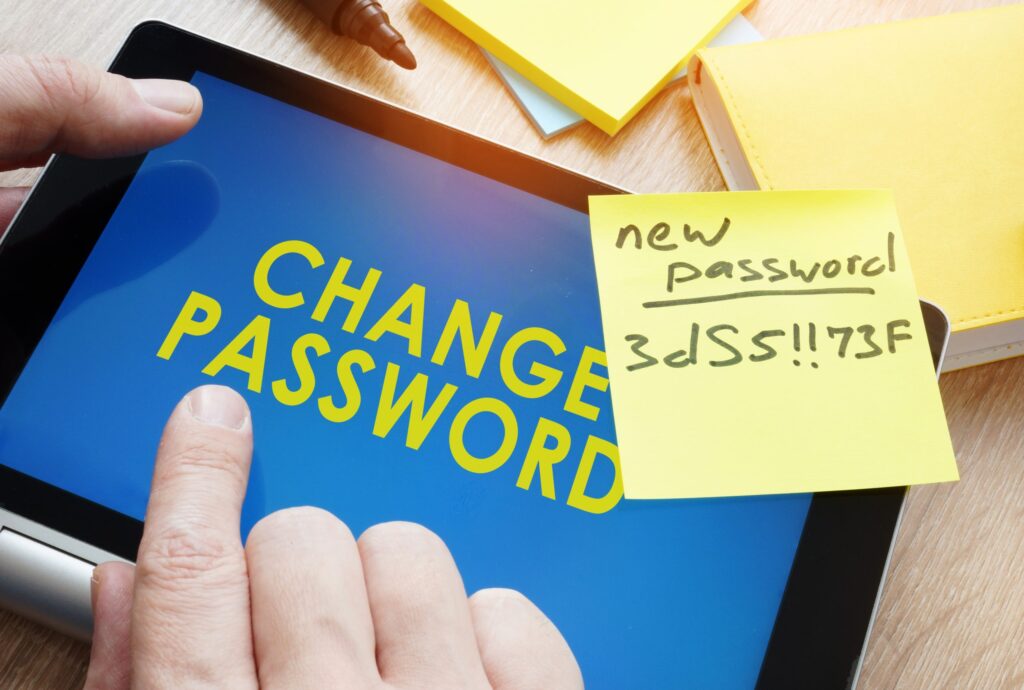
Abandoning arbitrary calendar schedules does not mean credentials should remain static forever. Instead of rotating on a timer, you must execute a targeted password reset based on specific structural threat indicators:
1. Following an Upstream Data Breach Disclosure
The moment a service provider issues a public notification regarding a database compromise, change your associated credentials immediately. Even if the vendor states that passwords were salted and hashed using modern cryptographic algorithms (such as bcrypt or Argon2), threat actors can pull down the database and attempt local offline brute-force matching. A swift reset ensures their extracted data is useless.
2. When Technical Telemetry Indicates Unauthorized Access
Do not wait for a complete account lockout to react. Initiate an immediate credential rotation if you observe any of the following system anomalies:
- Automated email alerts notifying you of a successful login from an unverified geographic location or device layout.
- Unsolicited Multi-Factor Authentication (MFA) push notifications or SMS TOTP codes hitting your phone when you are not actively logging in.
- Modifications to account parameters, outbound messaging histories, or security configurations that you did not authorize.
3. Following Exposure to a Phishing Intercept
If you realize that you accidentally clicked a lookalike typosquatting link and inputted your credentials into a fraudulent landing page interface, time is your critical defense parameter. Change your password across the official website immediately. If your authentication details match any other active online services, rotate those accounts sequentially as well.
4. Revocation of Shared Access
Whenever a credential must be provisionally shared with a family member, coworker, or temporary contractor, the profile’s integrity is downgraded. The moment that third-party access is no longer required, rotate the password string to re-establish a secure, single-user ownership perimeter.
5. Remediation of Low-Entropy (Weak) Credentials
If you maintain active accounts secured by legacy patterns, personal dates, sequential layouts (e.g., qwerty, 12345678), or strings shorter than 12 characters

Martins Osad is a technical writer and systems administrator specializing in network architecture and endpoint security operations. With over ten years of experience managing infrastructure deployment and configuring firewalls. All technical guides on Cybersafeguide are personally tested and verified in sandboxed environments.